
Table of Contents+
- AI Visibility Audit and Report for Semiconductor Etching Equipment Manufacturers
- Semiconductor Etching Equipment Manufacturers Have a Different AI Visibility Challenge
- How I Score AI Visibility for Semiconductor Etching Equipment Manufacturers
- Does AI Understand the Difference Between Your Equipment and Your Competitors' Equipment?
- The Technical Details That Can Change an Equipment Recommendation
- Can AI Identify the Customers Your Manufacturing Business Actually Serves?
- Why Equipment Qualification Matters to AI Recommendations
- Your Equipment Business May Be More Than Its Initial Machine Sales
- What Happens When AI Compares Established Manufacturers With Specialized Suppliers?
- How Emerging Etching Technologies Complicate AI Understanding
- What You Receive From the AI Visibility Audit and Report
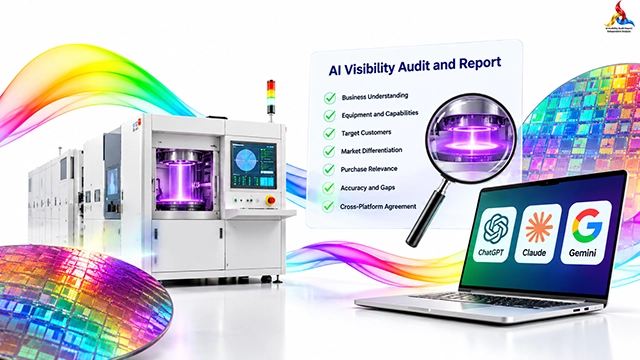
AI Visibility Audit and Report for Semiconductor Etching Equipment Manufacturers
If your business manufactures semiconductor etching equipment, the $495 AI Visibility Audit and Report investigates what ChatGPT, Claude, and Gemini understand about your equipment, process capabilities, customers, and competitive position. I examine whether these platforms accurately describe your manufacturing business, recognize the applications you serve, and identify you when relevant equipment suppliers are requested. Order your AI Visibility Audit and Report to receive an independent investigation of your business across all three platforms.
Semiconductor Etching Equipment Manufacturers Have a Different AI Visibility Challenge
A semiconductor equipment manufacturer can be recognized by name without being understood as a suitable supplier for a particular fabrication process.
Your company might manufacture plasma etching systems for compound semiconductors, deep reactive ion etching equipment for MEMS fabrication, or production systems designed for advanced memory devices. Those distinctions matter because customers are not simply purchasing a machine that removes material. They are evaluating whether a particular system can perform a defined process on specific materials under demanding manufacturing conditions.
That creates an important question about how AI platforms represent your business.
When someone asks about semiconductor etching equipment manufacturers, does the platform recognize your actual capabilities? Or does it place your business into a broad category alongside suppliers whose equipment serves entirely different applications?
The distinction between knowing your company exists and understanding when its equipment belongs in a purchasing discussion is central to an AI visibility investigation in this industry.
How I Score AI Visibility for Semiconductor Etching Equipment Manufacturers
I evaluate your business using seven categories totaling 100 points. Each category examines a different aspect of how accurately and completely AI platforms understand your manufacturing operation.
| Evaluation category | Points | What I investigate |
|---|---|---|
| What is your business? | 20 | Whether AI identifies you as a semiconductor etching equipment manufacturer rather than a chip fabricator, equipment distributor, or contract processing service |
| What do you sell? | 20 | Whether it recognizes your etching systems, process technologies, applications engineering, and equipment support |
| Who is it for? | 15 | Whether it identifies the correct customers, including foundries, specialty device manufacturers, research facilities, or other markets you actually serve |
| What makes you different? | 15 | Whether it recognizes documented technical capabilities, application specialties, and meaningful distinctions from other equipment manufacturers |
| When do you belong? | 15 | Whether AI considers your business relevant to purchasing questions that match your actual equipment and process capabilities |
| What is wrong, missing, or confused? | 10 | Whether it invents capabilities, overlooks important applications, confuses technologies, or misrepresents your company |
| Agreement across AI platforms | 5 | Whether ChatGPT, Claude, and Gemini provide consistent information about your business |
| Total | 100 | Independent assessment of your AI representation |
The scoring is supported by written findings explaining what each platform communicates and why those findings matter.
You can read more about the investigation process on the Our Approach page.
Does AI Understand the Difference Between Your Equipment and Your Competitors’ Equipment?
Semiconductor etching is not one uniform equipment market.
A manufacturer supplying deep reactive ion etching systems for silicon micromachining may have very different customers from a supplier specializing in conductor etching for advanced logic production.
Likewise, equipment intended for university research or process development is not automatically interchangeable with systems designed for high volume wafer manufacturing.
These differences create opportunities for AI platforms to misunderstand a manufacturer’s market position.
Consider a company specializing in etching equipment for silicon carbide and gallium nitride devices. If an AI platform describes that company only as a general plasma equipment manufacturer, it may omit the specialized applications that make the business relevant to a particular customer.
The opposite problem is also possible. An AI platform might recommend a manufacturer for advanced production applications without sufficient evidence that its equipment supports the required process.
Neither outcome gives the customer an accurate understanding of the supplier.
An AI visibility investigation examines whether the platform connects your business with the applications you actually support, rather than relying on broad equipment terminology.
The Technical Details That Can Change an Equipment Recommendation
Semiconductor equipment buyers evaluate process requirements that are much more specific than a product category.
Depending on the application, important considerations can include material selectivity, etch profile, uniformity, repeatability, substrate compatibility, throughput, and process control.
These are not interchangeable characteristics.
For example, a manufacturer offering atomic layer etching capabilities should not automatically be described as suitable for every application requiring conventional plasma etching. Similarly, an inductively coupled plasma system does not establish suitability for a particular compound semiconductor process without additional information.
There is another distinction that AI platforms need to handle correctly: equipment technologies often overlap.
Reactive ion etching, inductively coupled plasma, and atomic layer etching are not necessarily competing product categories. They can describe different aspects of a system’s architecture or process.
A platform that treats these terms as mutually exclusive may misunderstand both the equipment and the manufacturers offering it.
For your business, the investigation looks for whether AI accurately communicates documented technical capabilities without adding unsupported claims.
It also examines what happens when a platform lacks enough information to make a confident recommendation.
An answer that acknowledges missing technical evidence can be more useful than one that confidently assigns your equipment capabilities it does not have.
Can AI Identify the Customers Your Manufacturing Business Actually Serves?
The semiconductor equipment industry includes several purchasing environments, each with different requirements.
A major wafer fabrication facility may prioritize production capacity, process repeatability, equipment integration, and ongoing support. A MEMS manufacturer may need deep silicon etching capabilities for specialized structures. A research laboratory may place greater importance on process flexibility, substrate compatibility, and development assistance.
These differences affect which manufacturers belong in a customer’s initial supplier search.
A company that serves specialty semiconductor manufacturers should not automatically be evaluated against the same customer requirements as a supplier focused on large scale memory fabrication.
An AI platform may recognize your equipment but fail to understand your intended customer.
That can produce misleading descriptions of your market, inappropriate competitive comparisons, or recommendations for applications outside your actual capabilities.
The audit investigates whether ChatGPT, Claude, and Gemini understand the relationship between your products and the customers those products are designed to serve.
Why Equipment Qualification Matters to AI Recommendations
Semiconductor etching equipment purchasing is not simply a comparison of product descriptions.
Customers may need to establish that a system can achieve the required results on their materials and structures. Process development, equipment evaluation, acceptance testing, installation, and ongoing support can all influence the purchasing decision.
A supplier’s demonstrated ability to meet a particular process requirement can therefore be more important than the number of equipment categories listed on its website.
This creates a meaningful distinction between two kinds of information an AI platform might provide.
The first is a general statement that a manufacturer sells semiconductor etching systems.
The second is a more useful explanation of the applications the manufacturer supports, the technical capabilities it documents, and the evidence a prospective customer would still need to verify.
The audit examines whether AI platforms make those distinctions.
It does not independently certify equipment performance or validate manufacturing specifications. Its purpose is to investigate how the platforms understand and communicate your business, including whether they present technical claims with appropriate accuracy.
Your Equipment Business May Be More Than Its Initial Machine Sales
For many semiconductor equipment manufacturers, the commercial relationship continues after equipment delivery.
Installation, process development assistance, maintenance, replacement parts, software support, training, and equipment upgrades may form important parts of the business.
These services are particularly relevant when customers depend on qualified equipment for continuing manufacturing operations.
An AI platform that recognizes your machines but overlooks your actual support capabilities may present an incomplete picture of your company.
For example, there is a meaningful difference between a manufacturer that designs, builds, installs, and supports its own etching systems and a business that primarily resells previously owned equipment.
There is also a difference between an original equipment manufacturer offering technology upgrades and an independent service provider supplying replacement components.
The audit examines whether AI recognizes the products and services your business actually provides and avoids confusing your commercial role with another company’s.
What Happens When AI Compares Established Manufacturers With Specialized Suppliers?
The semiconductor etching equipment market includes major global manufacturers alongside businesses focused on particular technologies, materials, device structures, or research applications.
Companies such as Lam Research, Applied Materials, and Tokyo Electron have extensive equipment portfolios. Other manufacturers concentrate on particular processing requirements or customer segments.
That difference matters when someone asks an AI platform to recommend equipment suppliers.
A broad question about semiconductor etching equipment may produce a different answer from a question about a specialized process for compound semiconductors or MEMS devices.
A manufacturer should not necessarily expect to appear in every broad recommendation. Its relevance depends on the actual question and the capabilities being sought.
The important issue is whether AI recognizes the business when its documented capabilities match the customer’s requirements.
My investigation examines how each platform evaluates your company, where it places you in the market, and whether its explanations are supported by an accurate understanding of your business.
For owners who want a direct examination of a named competitor, the separate $895 AI Visibility Audit and Competitive Comparison investigates both businesses independently and provides a separate comparison of the findings.
How Emerging Etching Technologies Complicate AI Understanding
Semiconductor etching technology continues to develop as manufacturers address increasingly complex device structures and materials.
Advanced memory structures, selective material removal, cryogenic processes, and demanding three dimensional features are among the areas driving equipment and process development.
For equipment manufacturers, this creates a particular information challenge.
A company’s established product portfolio may be well documented, while newer process capabilities appear primarily in technical announcements, application materials, or specialized industry publications.
An AI platform might recognize the established equipment but overlook a newer capability. It could also mistake an announced development for a commercially available production system.
Those are different errors, and they require different interpretations.
The audit examines how AI represents your current business and whether its descriptions distinguish actual offerings from capabilities that have not been sufficiently established.
This is especially relevant when your company has expanded into new materials, introduced new process technologies, or changed the applications its equipment serves.
What You Receive From the AI Visibility Audit and Report
The $495 report is an independent investigation of one business across ChatGPT, Claude, and Gemini.
I use 15 structured diagnostic questions for each platform, followed by a sixteenth question requesting its recommendations based on the preceding findings.
The completed PDF includes the findings for each platform, the seven category evaluation, differences and agreement across platforms, each platform’s recommendations, and my separate independent recommendations.
The distinction between the platforms’ suggestions and my own analysis is maintained throughout the report.
You receive documented information about what the platforms understand, where their answers are incomplete or inaccurate, and which issues deserve your attention.
The service provides analysis and recommendations. It does not include website changes, marketing implementation, or equipment certification.
You can review both standalone report options on the Pricing page.
About the Independent Analyst
I’m Frank Masotti, the independent analyst behind AI Visibility Audit and Report.
I investigate how ChatGPT, Claude, and Gemini understand individual businesses and explain the findings in written reports. My work is independent analysis rather than an ongoing marketing or implementation service.
You can learn more about my background on the About Frank Masotti page or contact me with questions about the service.